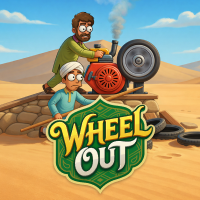
Wheel Out operates on a fundamentally different principle than many contemporary instant games. The entire round hinges on one decisive action: setting your stake and pressing SPIN. After that moment, the wheel is committed to its journey across the desert track, and the player transitions from actor to observer. There is no steering wheel to guide the path around obstacles, and critically, there is no manual cash-out button to lock in a favorable result partway through. The game resolves itself completely, following its programmed trajectory until it reaches either a safe landing zone or encounters a terminal hazard that ends the round immediately.
This automatic resolution creates a unique psychological experience. As the wheel rolls forward, you watch the running total respond to each track element it crosses. A +5 adder nudges the value upward steadily. An x3 multiplier suddenly triples whatever has been accumulated. The /2 Pigeons can devastate a promising run in an instant. Because you cannot intervene once the wheel is in motion, the entire experience becomes one of anticipation and reaction to events you cannot control. The viral appeal of Wheel Out in its origin markets stems directly from this high-stakes observational dynamic, where each launch tells a complete story from beginning to end without any mid-round decisions.
Understanding this core loop is critical before engaging with Wheel Out. You are not piloting the wheel or choosing when to exit. You are configuring the initial conditions—stake size and optionally the visual speed—and then witnessing the automatic outcome. The speed setting adjusts how quickly the visual sequence plays out, but it does not introduce any additional player control during the run itself. Once SPIN is activated, the round plays to completion on its own terms.